UnruffledAI
An AI wellness platform that spots rising burnout risk early and explains exactly what is driving it. I took it from a Figma prototype to a live service on AWS.
Quick view for recruiters
Problem solved
Burnout usually gets identified after someone has already checked out or quit. UnruffledAI predicts it early from behavioral data and shows its reasoning, so the person can act on it.
My role
I led delivery end to end. I defined the requirements, designed the data model, shipped the inference pipeline, tested it across every risk tier, and deployed it to AWS.
Technologies
Key accomplishments
- Turned a Figma prototype into a containerized service with automated CI/CD on AWS.
- Caught duplicate predictions and mismatched risk percentages in acceptance testing, before any user saw them.
- Rebuilt a third-party integration cache-first on a daily cycle so the app stops repeating calls.
- Secured the product before launch: credentials externalized, browser API access restricted, every record scoped to its owner.
Verified results
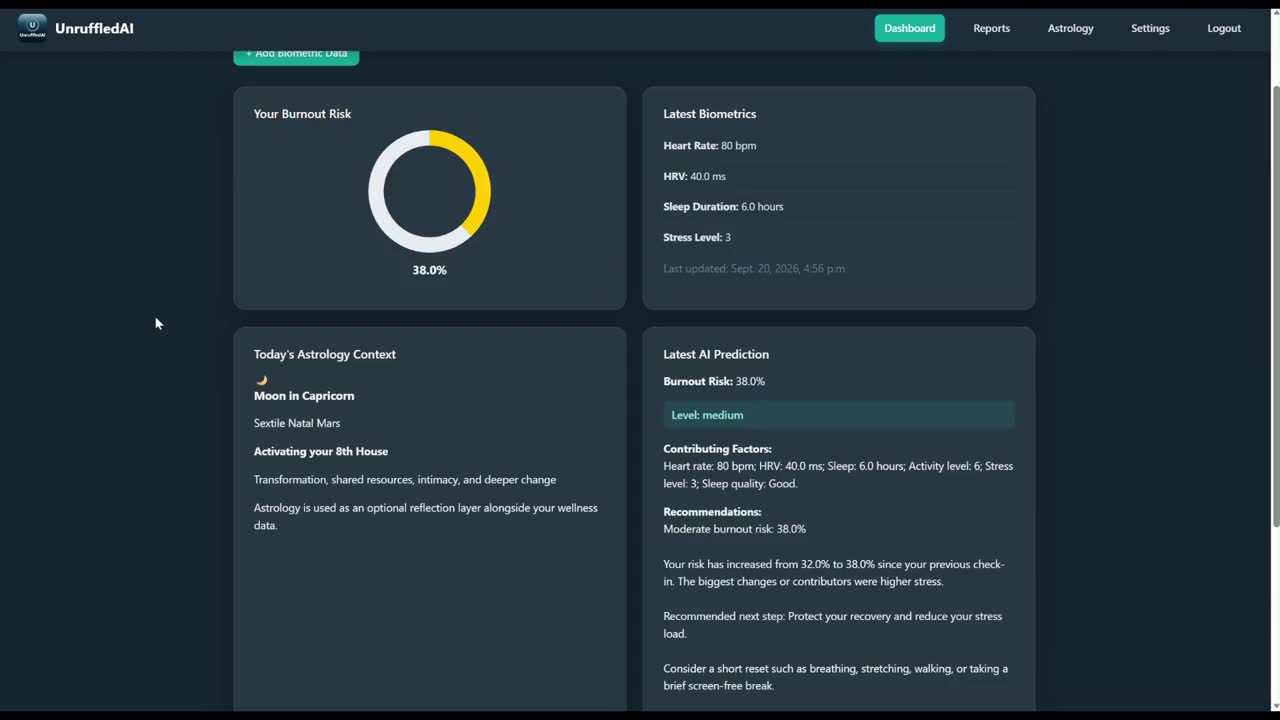
- In the walkthrough, one new check-in moves the score from 32% to 38%, shifts the level from low to medium, and names higher stress as the driver.
- Fixes re-validated across low, medium, and high risk tiers.
- Every result comes with a recommended next step and a clear note that it is a wellness insight, not a medical diagnosis.
Designed to be useful, not just accurate.
Explain every score
Each prediction lists its contributing factors and what changed since the previous check-in. In the walkthrough: “Your risk has increased from 32.0% to 38.0% since your previous check-in. The biggest changes or contributors were higher stress.”
Turn a score into an action
Recommendations match the risk tier. Medium risk suggests a short reset such as breathing, stretching, or a screen-free break. High risk points to recovery, a breathing exercise, or a short guided meditation.
Be clear about what it is
Every entry in the history carries the line “Wellness insight only; not a medical diagnosis,” so the product builds trust instead of overclaiming.
Show the trend
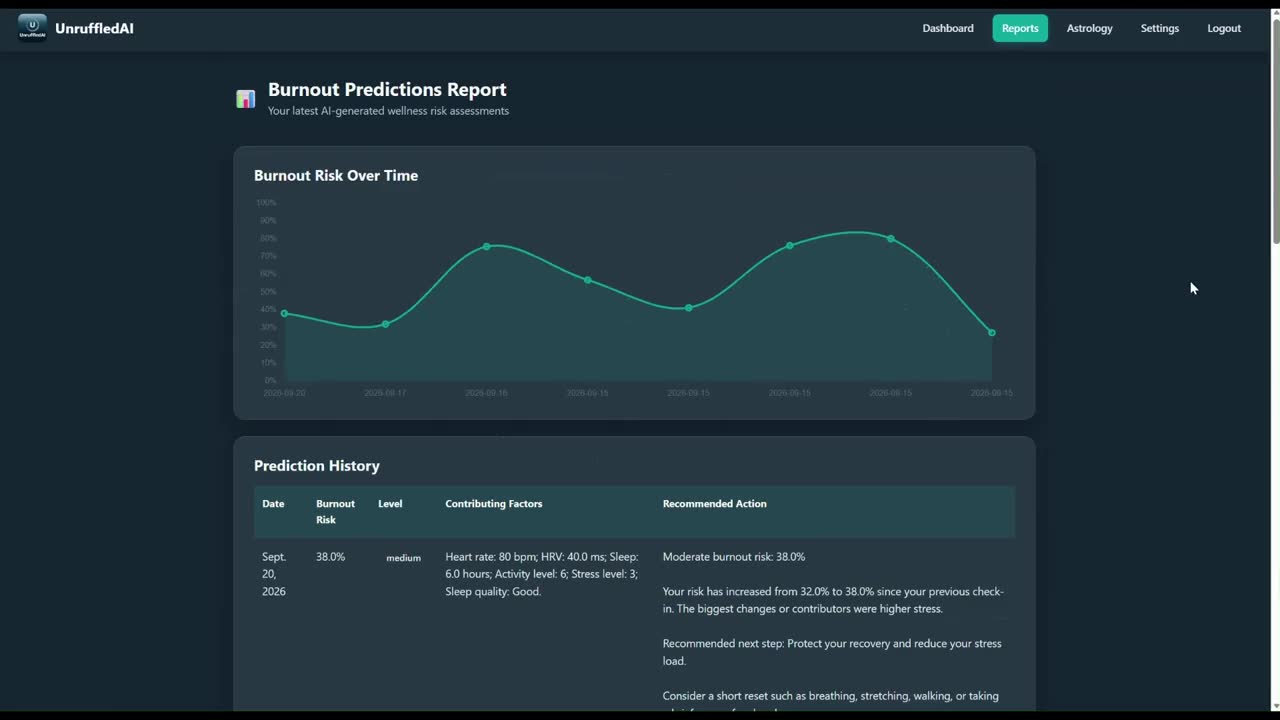
A Reports page charts burnout risk over time and keeps a prediction history with factors and recommended actions, so patterns become visible.
Keep the user in control
An optional reflection layer sits beside the wellness data. Settings covers notifications, privacy and data sharing, appearance, and wearable devices.
Plan the work as stories
I turned user requirements into prioritized features, user stories, acceptance criteria, and data requirements, starting from a Figma prototype.
How the pieces fit together.
- DesignFigma prototypeUser requirements became screens before any code.
- Internal · applicationDjango web appPrediction, reporting, and personalized experience workflows behind REST APIs.
- Internal · dataPostgreSQLApplication data, with every record scoped to the authenticated user who owns it.
- Internal · inferenceTensorFlow inferenceThe prediction step inside the application workflow.
- External serviceThird-party APIRetrieved on a daily cycle and served from cache first.
- DeliveryDocker, GitHub Actions, AWS EC2A containerized build with an automated deploy to AWS.
A high-level view. The model design, feature set, and data schema stay private while UnruffledAI grows toward a product.
What I connected, and owned.
Application and database
Core application workflows in Python and Django, backed by PostgreSQL for predictions, reports, and personalized user experiences.
Model inference
TensorFlow inference wired into the application so a new data point produces a recomputed prediction in the same flow.
REST APIs
REST APIs connecting the interface to prediction and reporting, with browser API access restricted.
Third-party data
I analyzed how the external API behaved, then redesigned the integration to retrieve data once a day and serve it cache-first.
Two problems, traced to the cause.
Duplicate predictions and risk percentages that did not reconcile
User acceptance testing surfaced duplicate prediction records and risk percentages that did not reconcile.
I traced the root cause instead of patching the symptom.
I added submission controls and corrected the reporting.
Re-validated across low, medium, and high risk-tier scenarios. Found and fixed before a single user saw it.
A third-party integration making redundant calls
The integration was requesting the same external data more often than it needed to.
I evaluated how the API actually behaved before changing anything.
I rebuilt the integration cache-first on a daily retrieval cycle.
Fewer redundant requests and more consistent data across the application.
Hardening before launch
Externalized, so secrets stay out of the code.
Browser API access restricted.
Every record scoped to the authenticated user who owns it.
How I made sure it works.
I ran user acceptance testing across the machine learning prediction workflows, isolated the defects above, and re-validated the fixes against low, medium, and high risk-tier scenarios.
The walkthrough below exercises the whole path: new data in, prediction recomputed, factors and next step explained.
UnruffledAI walkthrough.
1:36 walkthrough with sample data.
Chapters
- The dashboard: burnout risk at 32% (low), the latest biometrics, and the AI prediction with its contributing factors and a comparison to the previous check-in.
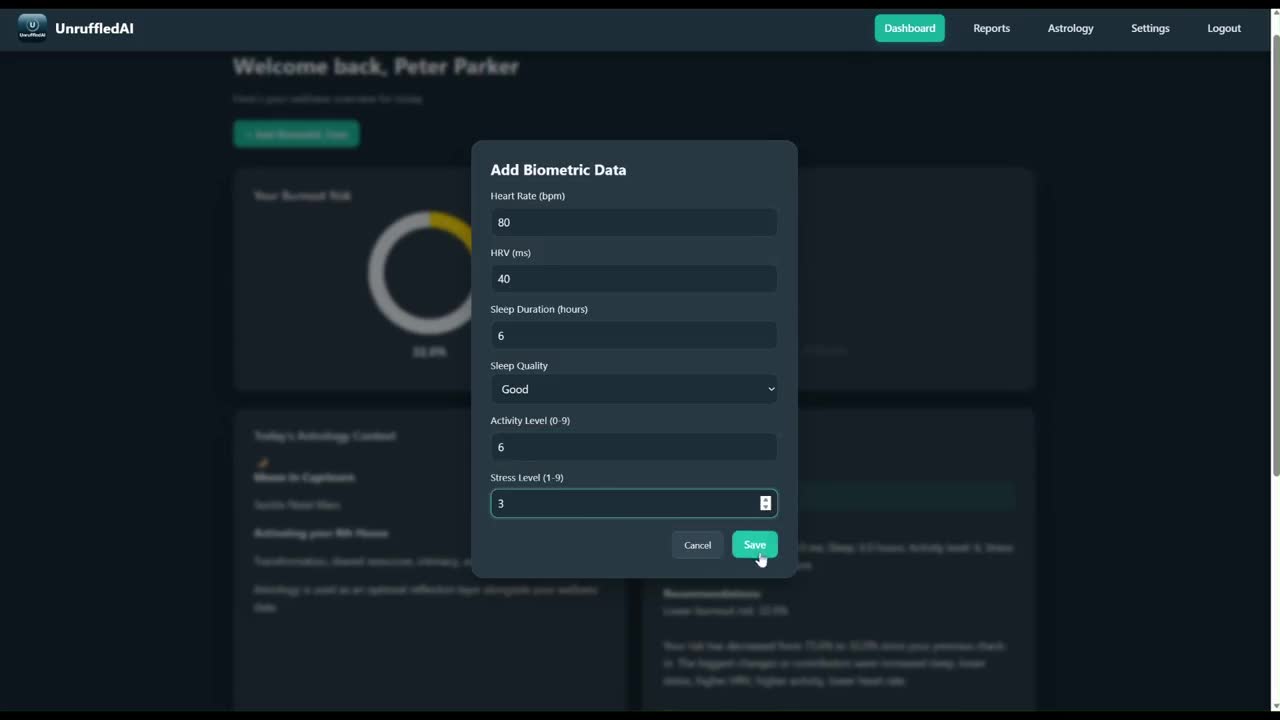
- A new check-in: heart rate, HRV, sleep duration, sleep quality, activity level, and stress level.
- Save, and the model analyzes the new data.
- The new result: 38% (medium). The explanation names higher stress as the driver and recommends a short reset.
- Reports: burnout risk over time, plus a full prediction history with factors and recommended actions.
- The astrology reflection layer: natal chart, the day’s transit, a reflection question, and planetary positions.
- Settings: feedback, notifications, privacy and data controls, appearance, and wearable devices.
Behind the demo
A check-in feeds the data model, the inference pipeline recomputes the score, and the interface presents the result with its explanation and next step. The model, features, and schema stay private as UnruffledAI heads toward a product.
Each skill, with the example behind it.
- Requirements to deliveryFigma · user stories · acceptance criteria
Prioritized features, stories, and data requirements from a prototype.
See requirements → - Application and data engineeringPython · Django · PostgreSQL · TensorFlow · REST
Core workflows, inference, and reporting in one application.
See integration → - Debugging and acceptance testingUAT · root-cause analysis
Duplicate records and risk percentages traced and fixed across every risk tier.
See the examples → - API and cost awarenessThird-party API analysis
Redundant calls replaced with a cache-first daily retrieval.
See the example → - Secure deploymentDocker · GitHub Actions · AWS EC2
Credentials externalized, access scoped, containerized build, automated deploy.
See the delivery path →
UnruffledAI is being built as a commercial product, so the model design, feature set, data schema, and infrastructure configuration stay private. This page shows the product thinking and engineering behind it, and I am glad to go deeper in conversation.
Ask me how I turned a customer problem into this product.
I am open to Forward Deployed Engineer, Solutions Engineer, Solutions Consultant, and Implementation roles.
spauleyinthecloud@gmail.com